Exercise Tiger
In late 1943, in preperation for D-day, the British Government set up a training ground at Slapton Sands in Devon to allow the American forces to rehearse for the D-Day invasion. The code name for this operation was 'Exercise Tiger.' The reason for the large scale rehearsals being performed in Slapton Sands, is because Slapton Beach was selected due to its similarity to Utah Beach, where D-Day was planned to take place.
Approximately 3,000 local residents in Slapton Sands were forced to evacuate. This was because villagers could not be aware of the plan and preperation for D-Day. As well as this, the American troops required accomodation and the homes of the villagers was the only option. Many people objected to the evacuation and thought it was an outrageous task to be asked to do because some people had never left their villages before being evacuated and they found it difficult to leave their homes.
Landing exercises started in December 1943. Exercise Tiger was one of the larger exercises that would ta
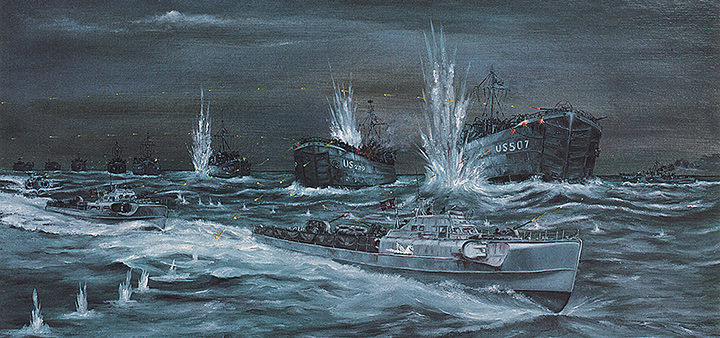
ke place in April and May 1944. The exercise was to be from 22 April until 30 April 1944. The landing exercises included all the aspects of the invasion. On board nine large tank landing ships (LST), the 30,000 troops prepared for their practise beach landing. The landing also included a live-firing exercise. Protection for the exercise area was supplied by the Royal Navy. There were two Destroyers and two Motor Gun Boats patrolling the entrance to the exercise area, and two Motor Torpedo Boats watched the Cherbourg area where German E-Boats were based. As the exercise went under way the LSTs suddenly found themselves under attack. The American servicemen were unaware that nine German E-boats had detected unusual radio activity in the area and had been ordered in investigate. It is believed that the E-boats encountered the two Destroyers and so immediately opened fire. LST number 507 was the first to be torpedoed. Lieutenant James Murdock stated that he noticed the boats on the radar but assumed that they were part of the exercise. As the German E-boats approached LST507 was suddenly hit by a torpedo on the starboard side which destroyed the side of the ship and exploded the engine room. LST507 had a crew of 447 men as well as the weight of trucks, jeeps and fuel, which caught fire. The flames spread and eventually the ship began to sink by the stern.
Within minutes of the previous strike, two more ships were attacked. LST531 was torpeddoed and sink in six minutes, with the loss of over of 400 lives. During the attack other LSTs opened fire on the enemy craft and sent frantic radio messages requesting urgent assistance. However, due to a typing error, using a different radio frequency to the LSTs, their calls intially went unanswered. In addition, due to the top secret nature of the operation, the radio stations along the coast also did not answer the calls until one radio operator heard the words 'T-4' and it was realised that the messages were coming from Exercise Tiger.
Unfortunately the attacks continued. The Germans tropedoed many other LSTs and the American crew were abandoned and left to fend for themselves. The loss of life increased as no help was being issued. 1405 serviceman and crew lost their lives and 749 servicemen and crew suffered major injuries. All those who took part in Exercise Tiger and its aftermath were sworn to secrecy. The Allies feared that if any information leaked to the enemy, plans for the D-Day Landings would be jeopardised. Ten officers who had been lost, were carrying detailed plans for the D-Day landings and, until these men could be accounted for, there were fears that the Normandy Landings would have to be cancelled altogether. It would be many months before the US military authorities revealed minor details of the events of that night, and over forty years before the whole story was disclosed.